Team NYAI
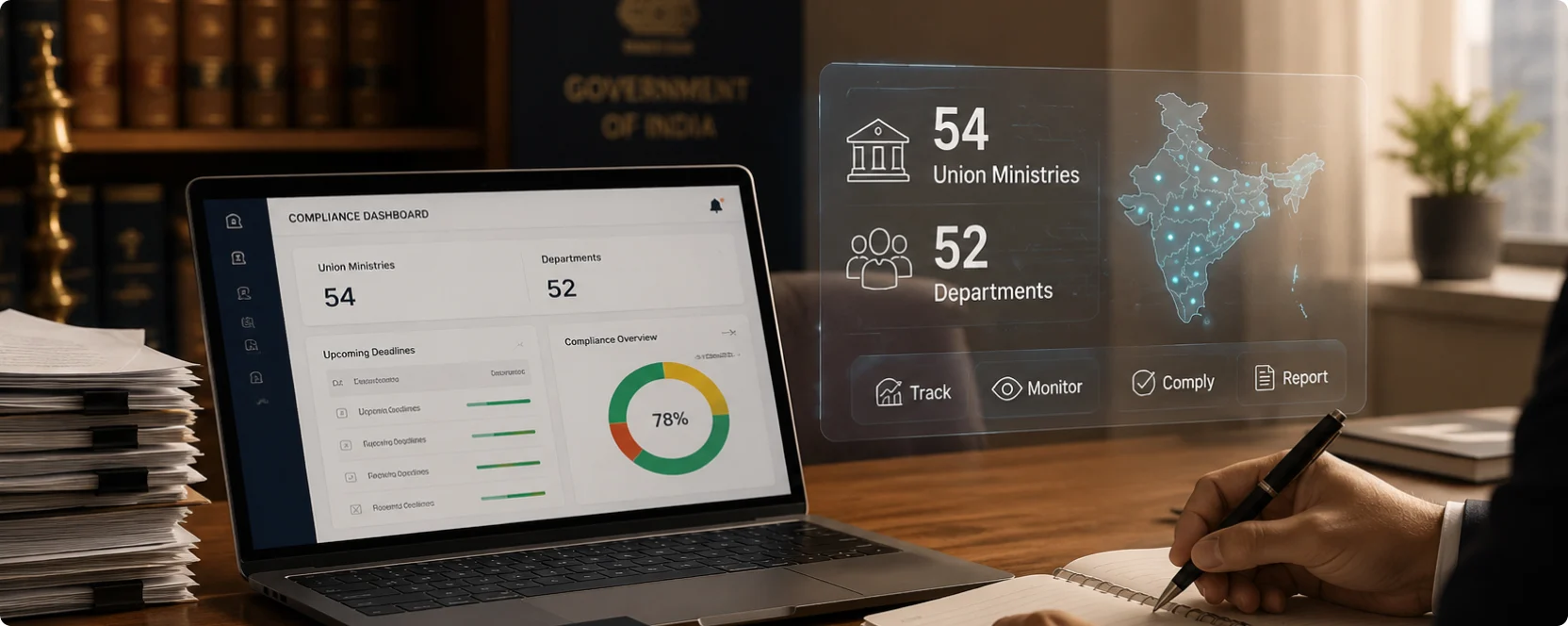
Indian compliance operates at a scale that exceeds manual capacity. The solution is not bigger teams. It is a smarter infrastructure.
The Government of India operates through 54 Union ministries and 52 departments and that is only the visible structure. Below it sits a wider regulatory surface: sectoral regulators with quasi-legislative authority, 28 state legislatures, three Union Territory legislatures, and the municipal byelaws of every jurisdiction in which an enterprise functions. In FY 2024–25, this surface produced 9,331 regulatory updates across seven categories of law, as recorded by TeamLease RegTech in its 2025 study of Indian manufacturing MSMEs.
That is roughly 26 updates per working day. The scale is real. But scale is not the difficulty. Velocity and interconnection are.
What 'tracking' actually means
A typical Indian enterprise is not tracking one regulator. It is tracking layers.
It tracks primary legislation the Companies Act, 2013, the Income-tax Act, 1961, the Central Goods and Services Tax Act, 2017, the Digital Personal Data Protection Act, 2023, and dozens of others. It tracks subordinate legislation rules, regulations, notifications, master directions, circulars, advisories, FAQs each carrying a different legal weight. It tracks sectoral regulators with rule-making power: the Reserve Bank of India, the Securities and Exchange Board of India, the Insurance Regulatory and Development Authority of India, the Competition Commission of India, the Food Safety and Standards Authority of India, and the Central Drugs Standard Control Organisation, among others. It tracks state legislatures and local authorities. And it tracks judicial pronouncements that reinterpret existing obligations.
The compliance universe reflected in TeamLease RegTech's national database runs to 1,536 Acts and 69,233 distinct compliances. Jailed for Doing Business, the 2022 study by Rishi Agrawal and Gautam Chikermane of the Observer Research Foundation, identified 26,134 imprisonment clauses across India's business laws. For a single mid-sized enterprise a solar plant in Maharashtra with a corporate office in Haryana TeamLease RegTech maps 799 unique regulatory requirements (646 central, 153 state and municipal) translating to 2,735 annual compliance instances.
Visible regulation is what gets reported. Lived regulation is what gets missed.
Why headcount stops working
Large Indian enterprises now operate substantial compliance teams. Hiring in compliance has grown steadily through the past decade. The constraint is no longer effort. It is structured.
Three pressures explain why linear team growth cannot keep pace.
The first is lag. By the time a notification is read, interpreted, routed and acted on, the obligation window has often narrowed. A manufacturing MSME in India faces, on average, 42 regulatory changes per day. No team scales to that pace without compounding errors.
The second is translation. Legal text does not arrive as a checklist. A circular has to be converted into a specific obligation owner, deadline, evidence requirement, dependency on other rules. That conversion is the slow step, and it is the step under which manual processes break.
The third is traceability. As compliance teams scale, audit trails fragment across spreadsheets, inboxes, and individual judgment. When a regulator asks how a decision was made and when, fragmented records are not a defence.
The four layers of compliance infrastructure
Compliance, properly built, is not a function. It is a system. The system has four layers.
Ingestion. Continuous, multi-source capture of regulatory output central gazettes, ministry portals, regulator websites, state publications, judicial orders. Completeness is a function of system design, not diligence.
Classification. Relevance filtering by entity, sector, jurisdiction, and operational function. Most regulatory output is not material to any given enterprise. The discipline is separating signals from background.
Mapping. Translation of a notification into a specific obligation: owner, deadline, evidence, dependency on other rules. This is the layer where most manual workflows break. It is also the layer where purpose-built legal AI changes the economics, by reading regulatory text at scale, identifying obligations, and producing the structured record that institutional compliance requires.
Alerting and traceability. The right person, in the right window, with a defensible record of when an obligation was identified, assigned, and closed.
Four layers, working in sequence, do work that headcount cannot do reliably at this scale.
What changes when compliance becomes architecture
The strategic implications are immediate.
Compliance moves from reactive to anticipatory. Board reporting becomes evidence-backed rather than narrative. Regulator interactions are supported by traceable workflows. Legal risk modelling becomes credible because the underlying data is structured.
The Indian regulatory cycle of 2023–2025 has already made this shift unavoidable. The Bharatiya Nyaya Sanhita, 2023, the Bharatiya Nagarik Suraksha Sanhita, 2023, and the Bharatiya Sakshya Adhiniyam, 2023 took effect on 1 July 2024 a wholesale recodification of Indian criminal law that touches every contract, policy and template in which the Indian Penal Code, 1860 was once cited. The Digital Personal Data Protection Rules, 2025, notified on 13 November 2025, set a substantive compliance deadline of 13 May 2027 with penalties up to ₹250 crore. The Reserve Bank of India's FREE-AI Committee Report of 13 August 2025, the Securities and Exchange Board of India's AI/ML consultation paper of 20 June 2025, the Central Drugs Standard Control Organisation's draft Medical Device Software guidance of 21 October 2025, and the Maharashtra Stamp (Amendment) Ordinance, 2024 of 14 October 2024 are not isolated developments. They are the surface signs of a regulatory architecture being rebuilt at pace.
The enterprises that will navigate the next decade well are not the ones with the largest compliance teams. They are the ones with the most defensible compliance infrastructure.
Compliance is no longer a department. It is the substrate on which corporate legal capability now stands
Share on
|
X